
Paintings I love
Joaquim Mir Trinxet (Spain, 1873 – 1940)
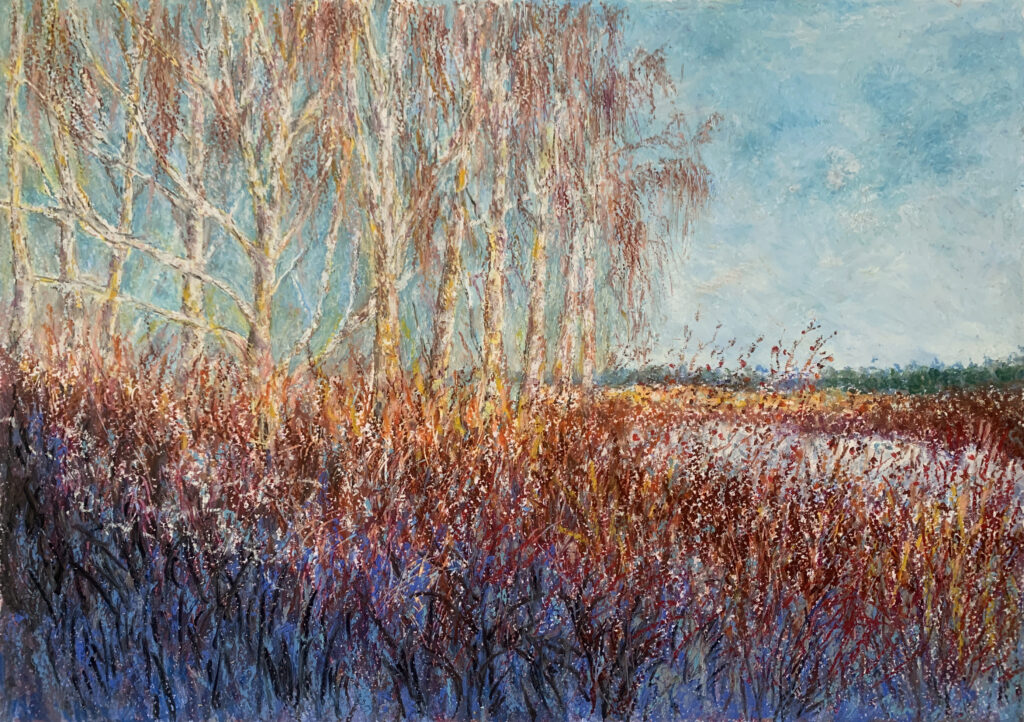
The Stream
1919
Oil on canvas, 90 x 125 cm.
National museum of fine arts, Buenos Aires, Argentina
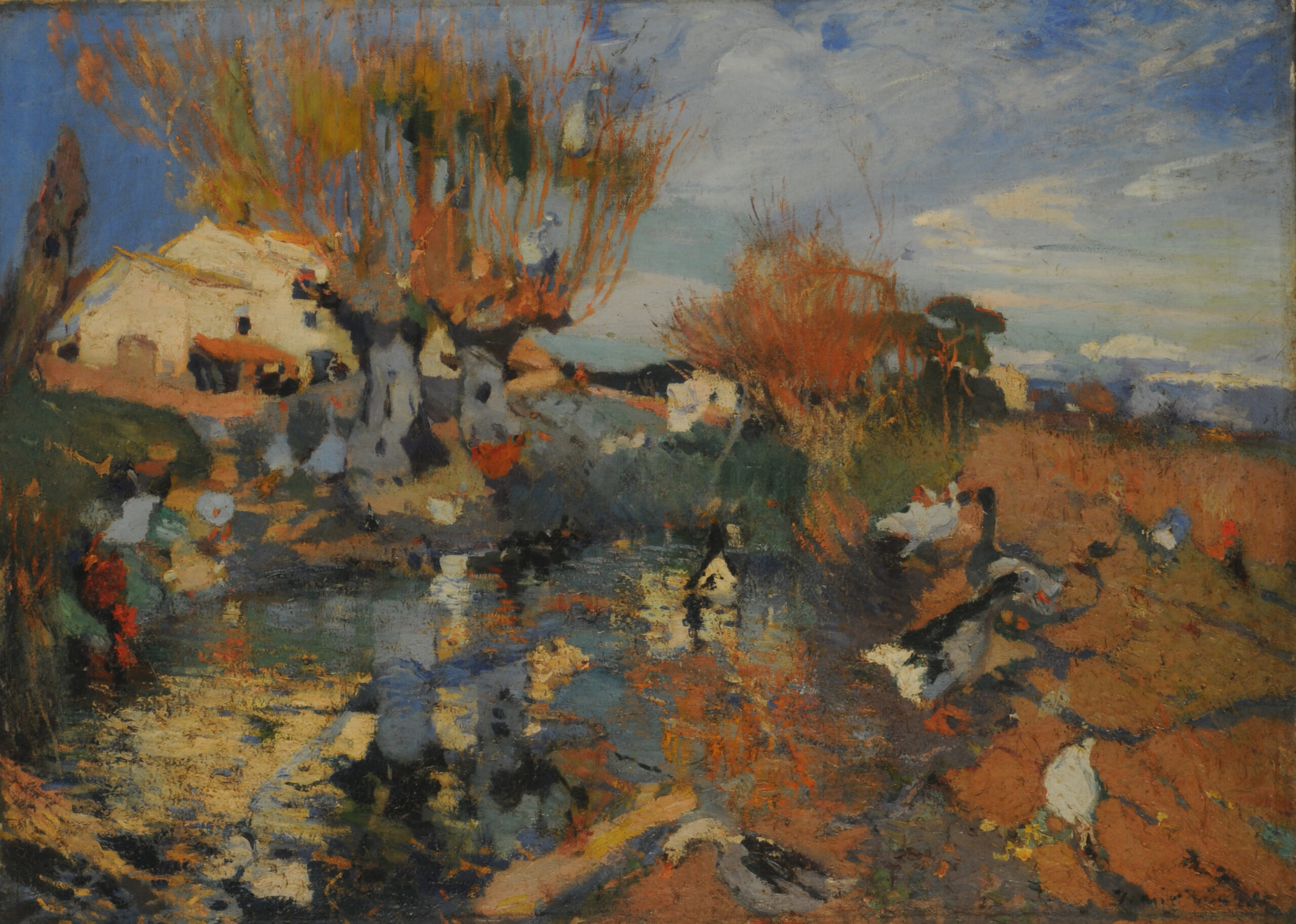
Joaquim Mir belongs to the second generation of Catalan Modernism, initiated by Ramón Casas and Santiago Rusiñol, which had its center of dissemination in the gatherings of the Barcelona café Els Quatre Gats.
After having been part of the group La Colla del Safrà – inclined by the suburban theme in an expressionist key – at the beginning of the 20th century, accompanied by Santiago Rusiñol, he traveled to Mallorca and changed his aesthetic interests. He settled in a small village called Sa Calobra, turning his painting almost exclusively towards the landscape. The expressionist intention remained and found a more complete manifestation through color, with the use of impressionist filiation techniques. His palette was enriched with a varied and extreme chromaticism, through which he captured the atmosphere, the sky, the water and the cliffs, building a personal language where the subject gave way to matter, color and light. His exaltation of nature led him to venture into unexplored corners and places of difficult access.
Unlike the other Catalan modernists, Mir never went to Paris: he had no direct contact with the environment where impressionism or post-impressionism had arisen. His chromatic translation of reality dissolved depth and space in the superposition of spots, but without theoretical foundation but rather intuitively.
Although the treatment of color and brushstrokes position him as the painter most closely related to Impressionism in Spain during the first decades of the 20th century, his production never lost the figurative structure, characteristic of Spanish painting of the time. However, on this canvas, the fantasy of color, the distortion of shapes and the superposition of spots bring it closer to a marked abstraction.
This poetic interpretation of the landscape, not without solidity, which uses the freedom of tonal possibilities as a tool, remains constant in Mir’s work, although since 1920 the form has progressively regained prominence in his painting and by 1930 the values chromatic ones are recovering their realistic character.
Source: National museum of fine arts, Buenos Aires
Follow my art blog “Paintings I Love” in Instagram, Telegram, Pinterest, Twitter
Related Posts