
Paintings I love
Joaquín Sorolla y Bastida (Spain,1863 – 1923)
On the Valencian coast (En la costa de Valencia)
1898
Oil on canvas, 57 x 88,5 cm.
National museum of fine arts, Buenos Aires, Argentina
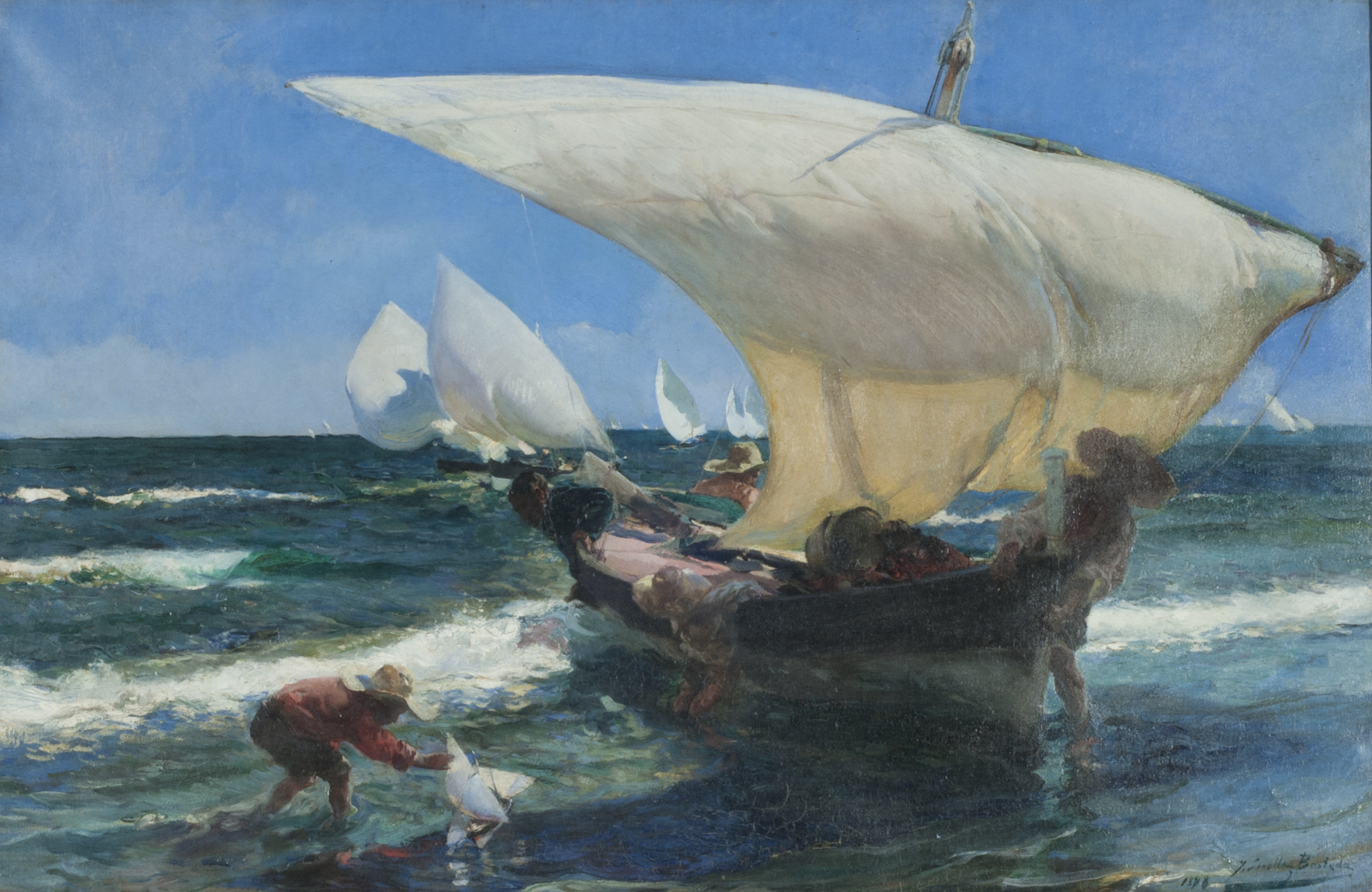
This costumbrist scene representing fishermen at work returning with the day’s catch and a young boy playing may well be a depiction of the beach at Cabañal. Sorolla frequented the beach, which around 1900 would typically bring together fishermen and their families as well as painters looking for themes representing regional identity. This combination of pre-industrial labor carried out by the working class on the one hand and outdoor painters with hints of nationalism on the other provided an optimistic image of the Levante region of Spain, as opposed to the hard transformation process that industrialization brought to the region’s landscape.
Sorolla created a “maniera” or style that could be emulated on a compositional level and that was thematically “digestible” in spite of its modernity. His luminous technique was diametrically opposed to the structured palette of cold academicism that had enthroned history painting along with its contrived compositions. However, Sorolla’s deliberate organization of masses of light and color brought him closer to academic thinking and preferences for thoroughly composed canvases that maintained forms and color strictly in balance. His adhesion in part to impressionist technique should not be confused with an adoption of discoveries regarding luminous impressions achieved by way of juxtaposing pure colors, relegating structure to a secondary plane, or with a dissolution of form—all divergences from impressionism that united him with the rest of the luminists—although his approach tends to oscillate toward brushstrokes with impressionist comatic aberrations.
The velocity and a particular impression inherent in Sorolla’s poetics would never be completely emulated by his followers. In reference to the themes handled, the artist opted for descriptions of a golden age in the Mediterranean, an Arcadia where he presents us with men in simple, sweet harmony with nature. The fishermen’s gestures and the little boy playing in the water represent the flow of all things and are ephemeral. Even so, these moments evoke the eternity of this region’s types of humanity.
Source: National museum of fine arts, Buenos Aires
Related Posts